You might also hear it called:
- Training mannequin
- Resuscitation mannequin
- Practice manikin (a technically correct variant spelling)
Or, more casually: CPR dummy or practice dummy
However, in professional settings—like medical, fire, or safety training—“mannequin” or “training mannequin” is preferred.
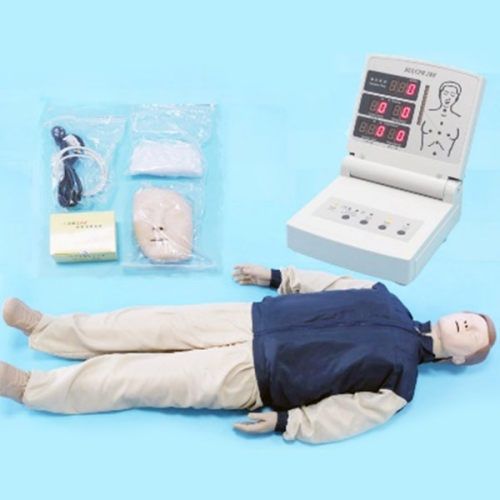 Multifunctional Electronic CPR Simulator
Why Does the Name Matter?
Using the correct terminology helps in a few key ways:
Clear Communication: In training or emergency drills, everyone knows exactly what equipment is being referred to.
Respect for the Tool: These aren’t toys; they’re precision training tools designed to save lives. Accurate language reflects their purpose.
Searchability: If you’re looking to buy or learn more, searching “CPR mannequin” will yield better results than vague terms.
A Quick History Lesson: Meet “Rescue Annie”
You might have heard the iconic name Rescue Annie (or Resusci Annie). This isn’t just a nickname—it’s the name of one of the most famous and historically significant CPR mannequins.
Origin: Introduced in the 1960s by Norwegian toymaker Åsmund S. Lærdal.
The Face: Her face was reportedly modeled after the mysterious “L'Inconnue de la Seine” (the Unknown Woman of the Seine), a death mask from 19th-century Paris.
Legacy: “Annie” became so popular that her name is often used generically for any CPR mannequin, much like “Kleenex” for tissues.
Types of CPR Mannequins (It’s Not One-Size-Fits-All)
Not all mannequins are the same. Here’s a quick breakdown:
| Type | Best For | Key Features |
| Adult CPR Mannequin | Standard adult CPR training | Full torso, realistic airway, feedback sensors (in advanced models) |
| Infant/Child Mannequin | Pediatric training | Smaller size, specific techniques for babies/children |
| AED Training Mannequin | Practicing defibrillator use | Includes sensor pads for attaching AED electrodes |
| High-Fidelity Manikin | Advanced medical simulation | Electronic feedback, chest rise, pulse simulation, voice interaction |
Pro Tip: If you’re buying for a business or organization, look for mannequins that comply with American Heart Association (AHA) or Red Cross guidelines.
What to Look for in a Training Mannequin
Whether you’re a school, workplace, or individual getting certified, here are the essentials:
Durability: Can it withstand repeated use and cleaning?
Realism: Does it allow for proper head tilt, chin lift, and chest compression practice?
Hygiene: Look for replaceable airways and face shields, or easy-to-clean surfaces.
Feedback Capability: Some models have sensors that indicate correct compression depth and rate—extremely helpful for learning.
The Bottom Line
So, what do you call it?
In most cases, CPR mannequin is your best bet.
But now you know the whole story—from the iconic Rescue Annie to the high-tech simulators used in modern training.
Remember, the goal isn’t just knowing the name, but understanding how to use the tool effectively. Because at the end of the day, it’s not about the dummy—it’s about being prepared to save a life.